Our work / AI in hiring
A system that gives candidates realistic tasks from the role, uses AI to review how they do the work, and gives hiring teams a shortlist backed by evidence.
- Applications
- 366
- Passed profile screening
- 195
- Took the AI assessment
- 199
- Qualified on the assessment
- 6
 Placeholder: confirm role and numbers may be shown
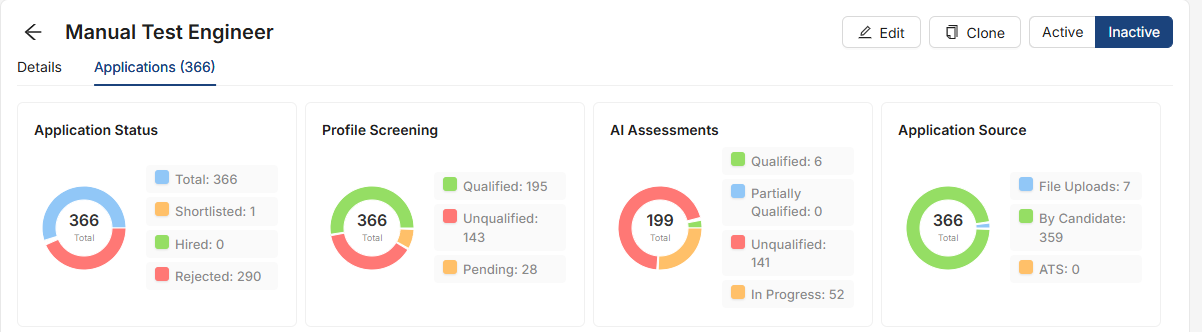
Fig. 1 The hiring team’s view of one role, here a Manual Test Engineer, one of the roles the approach covers beyond AI engineering. Every application, how it was screened, and where each candidate stands. Counts are from a live hiring drive.
- Input
- The job description, and each candidate’s work on the simulation
- What it does
- Reviews how each candidate approached, solved and explained the task
- Output
- A ranked shortlist, with a report for every candidate
- Where it runs
- On our hosted platform, qualifyme.ai
The problem
A resume and a short interview tell you little about whether someone can do the job. Hiring teams know this, so they put senior engineers into round after round of interviews, many of them with candidates who were never a fit.
For newer roles like AI engineering, the gap is wider. Job titles vary, experience is hard to verify, and recruiters can’t judge the technical work themselves. Good candidates get missed and weak ones get through.
Why a standard test falls short
Online tests and quizzes were built for a time when candidates worked alone. That has changed.
Resumes are easy to inflate.
When we screened for AI engineering roles, we saw the same overstated projects and skills appear across many resumes.
AI tools can answer standard questions.
A candidate can paste a quiz question into an assistant and get a correct answer in seconds. The test measures the tool, and tells you nothing about the person.
Real work has more than one right answer.
Two good engineers can solve a task in different ways. Scoring has to judge the approach and the reasoning, which a multiple-choice test can’t do.
How we built it
Build the simulation from the role
We turn the job description into a task someone in that role would do in their first weeks, such as fixing a bug, building a small feature or designing a prompt.
Let the candidate work as they would on the job
Candidates work in a browser workspace with the tools the role uses, and explain their choices as they go.
Review the work with AI
A language model reviews the result, the approach and the explanation against a rubric written for that role, and notes activity that suggests outside help.
Give the hiring team the evidence
Each candidate gets a report with scores, the work itself and the reasoning behind every score. The team sees a ranked shortlist.
Under the hood
- Rubric-based scoring with language models, with each score tied to a specific part of the candidate’s work
- Integrity signals such as paste events, tab switches and timing patterns
- Candidates are invited and followed up on WhatsApp. In our hiring drives, over 90% replied there, against under 20% on LinkedIn
- Results export to a spreadsheet or the team’s applicant tracking system
Choices we made on purpose
The work comes before the resume.
Every candidate gets the same task, so a strong engineer from a small company has the same chance as one with a famous employer on their CV.
Every score shows its reasoning.
A hiring manager can see why the system scored a candidate the way it did, and disagree. The system ranks candidates. People make the hire.
Candidates are reached where they reply.
Most candidates in India read WhatsApp within minutes and ignore email for days, so invitations and reminders go there.
The first use case: hiring AI engineers
We built it to solve our own problem. We needed engineers who could build with AI, and resumes for those roles were the least reliable we had seen.
In our screening, the simulations brought out two things a resume never shows:
- Experience that didn’t hold up once the candidate had to do the work
- Answers written by an AI assistant, visible in how and when the work appeared
The same approach works for any role where you can describe a realistic task.
- Software developers
- Data analysts
- QA engineers
- Customer support
- Technical writers
Hiring for a role that’s hard to screen?
Tell us about the role. One of the founders will reply within a working day.